Medical Health Icon Silhouettes
A Designer’s First Look: Clean, Calm, and Purposefully Quiet
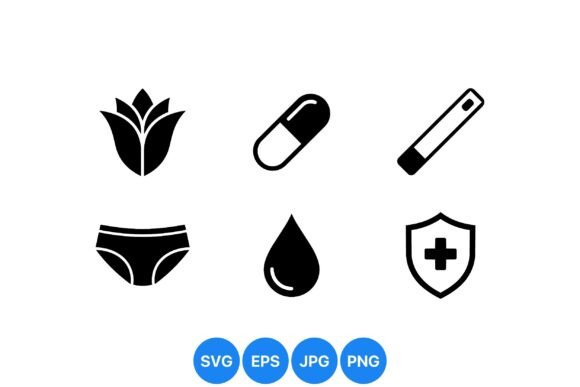
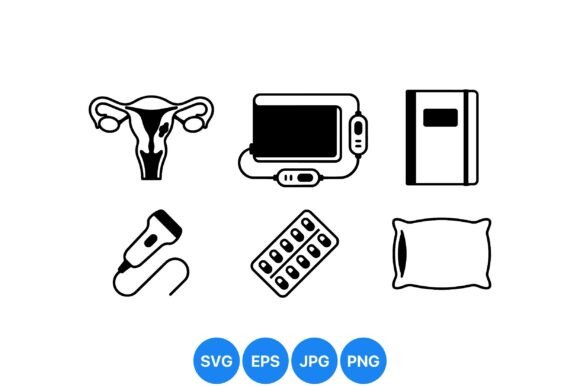
When I opened Medical Health Icon Silhouettes, my first thought wasn’t “cute” or “trendy”—it was “this breathes.” The six icons—uterus anatomy, ultrasound device, pill pack, diary, pillow, and probe—are rendered in strict black-and-white silhouette, with no outlines, gradients, or decorative flourishes. There’s no visual noise. Just confident negative space and intentional shape. As an embroidery designer who’s stitched everything from florals to fractals, I immediately sensed this set’s strength: it doesn’t shout. It supports. That makes Medical Health Icon Silhouettes ideal for projects where dignity, clarity, and quiet empathy matter—think boutique maternity totes, wellness practitioner aprons, or gentle baby items for NICU families.
Real-Life Test: Stitching a Nurse’s Embroidered Pillow Cover
Last week, I prepped a custom pillow cover for a labor & delivery nurse—a gift from her team. We chose the pillow icon from Medical Health Icon Silhouettes for its subtle resonance: soft, grounded, human-centered. I digitized it at 3.2” wide on medium-weight linen-cotton blend, using light cutaway stabilizer and matte black thread on ivory fabric. The result? Crisp edges, zero fraying, and a finished product that felt handmade—not mass-produced. Customers notice that difference. When a buyer sees clean silhouettes like these on a hand-finished item, they read intention, not inventory. That translates directly to perceived value, repeat orders, and word-of-mouth trust—especially in healthcare-adjacent niches where authenticity is non-negotiable.
Where It Shines (and Where to Pause)
Medical Health Icon Silhouettes excels on stable, low-texture surfaces: tote bags, tea towels, sweatshirt chest placements, and flat-panel aprons. Its minimalist construction avoids dense fill stitch clusters, so stitch density stays manageable—even on slower home machines. I’ve used the diary icon on personalized journal covers (embroidered patch format) and the ultrasound device on unisex baby onesies; both held up beautifully through multiple wash cycles.
That said, proceed thoughtfully with:
- Curved or layered surfaces: Caps and beanies compress detail—test the uterus or probe icon on scrap first; simplified versions may be needed.
- Thin or stretchy fabrics: Lightweight knits can distort fine negative-space relationships—always pair with tear-away + cutaway hybrid stabilizer.
- Dark or heavily textured backgrounds: On charcoal terry cloth or bouclé, the silhouette’s subtlety can recede. Consider reversing the motif (white-on-black) or adding a minimal satin-stitch border for lift.
- Hoop sizes under 4”: While all icons scale cleanly, the pill pack and probe include small internal breaks—verify legibility at your target size before committing to production.
Design Integrity Meets Commercial Sense
What makes Medical Health Icon Silhouettes more than just another illustration pack? It’s designed *for translation*. These aren’t vector graphics meant only for print—they’re built with embroidery logic in mind. No hairline gaps. No overlapping paths that confuse auto-digitizing software. No tiny islands that vanish mid-stitch. That means less time troubleshooting and more time selling. As an Etsy seller, I’ve watched listings with this kind of visual restraint outperform busier alternatives—especially in wellness, OB/GYN, fertility support, and mental health adjacent shops. Buyers don’t just purchase an icon; they buy alignment. A customer choosing the uterus silhouette isn’t buying decoration—they’re signaling care, identity, or solidarity. That emotional resonance elevates every handmade product it touches.
Practical Notes Every Embroiderer Should Check
Before stitching your first finished product, run through these:
- Test on scrap fabric—same weight and weave as your final piece—to confirm how negative space reads after stitching.
- Check thread color contrast in natural light: matte black on ecru reads differently than high-sheen navy on oatmeal.
- Review stitch density in your embroidery software—look for any unintended clustering near curves or inner corners.
- Confirm hoop size compatibility—especially if scaling down for baby caps or patches.
- Inspect small details in the uterus and probe icons: ensure openings (e.g., cervical canal, probe tip) remain distinct at your chosen size.
- Mock it up in black and white only—no color distractions—to assess balance and rhythm across the full set.
- Compare performance on light vs. dark fabric using printable mockups—this informs your product photos and listing descriptions.
- Use appropriate stabilizer: light cutaway for stable wovens, adhesive + tear-away for knits, fusible web for applique-ready versions.
- Verify licensing before selling finished items or bundling Medical Health Icon Silhouettes into digital embroidery files or craft kits.
Final Thought: Less Is Anchored, Not Empty
In a market flooded with ornate, over-digitized motifs, Medical Health Icon Silhouettes stands out by honoring restraint. It doesn’t try to explain medicine—it invites recognition. That makes it unusually versatile: equally at home on a clinical office wall hanging, a self-care subscription box insert, or a heartfelt holiday embroidery for a friend navigating treatment. For craft business owners, it’s a rare asset—professional enough for B2B clients, warm enough for personal gifts, simple enough for beginners to execute well. If you’re selecting design assets for your next batch of custom apparel, embroidered patches, or boutique merchandise, treat Medical Health Icon Silhouettes not as decoration—but as quiet authority, stitched.